Northamptonshire Biodiversity Records Centre

Camera trap recording with the Northants Mammal web project

Authored by
NBRC Centre Manager
Date
18-10-2021
Image
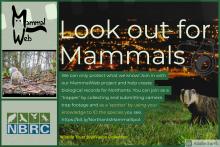
'Look out for...Mammals' Mammal Web Survey

Camera traps have given us a new view of the shyer species living alongside us. Help Northants as a ‘trapper’ by uploading your footage and as a ‘spotter’ by reviewing footage and identifying the species for biological records. Work together in our ‘Look out for…mammals’ with Mammal Web. Protection starts with what we know.
Look out for Rabbits!

Look Out For Rabbits image with logos

Spring is in the air and we'd like to present you with a challenge by joining in with our Look out for Rabbits! survey.  Although thought to be common and widespread in Northamptonshire, we have relatively few records of rabbits in Northants and there are large areas of the county for which we have no records at all.

Personal details
*

Please provide your first name

*

Please provide your surname

*

Please provide your email address. This will only be used to contact you if we require further information to verify the record.

 *

Enter the date in dd/mm/yyyy format or select the date of the record.

You are submitting a record of Oryctolagus cuniculus
 *

Enter the recorder's name, if different


Provide an indication of the abundance


How certain of this identification are you?


Please indicate the sex of the organism, if recorded.


Please indicate the life stage of the organism, if recorded.


If anyone helped with the identification please enter their name here

Please add any additional information you think may be of interest

Sensitivity

This is the precision that the record will be shown at for public viewing

 *

Please provide the location name. This could be the name of a village, town, parish, nature reserve, wood etc. Do not enter a postal address as the information you provide will be visible to others.

Further details about where the sighting was within the main location, e.g. a road name, footpath, a compartment of a wood, or area of a nature reserve.

 *

Or simply click on your rough position on the map.


Standard Data Search

A standard NBRC data search for a given area will provide a map and a report (PDF) including:

  • Location of statutory sites that have been designated as; Special Protected Areas (SPAs), Sites of Special Scientific Interest (SSSI), National Nature Reserves (NNRs) or Local Nature Reserves (LNRs).
  • Location and where available, descriptions of non-statutory sites that have been designated as Local Wildlife Sites (LWS), Protected Wildflower Verges (PWV), Wildlife Trust Nature Reserves, Local Geological Sites (LGS), Pocket Parks, Important Invertebrate Areas (IIA) and Potential Wildlife Sites (PWS).
  • Lists of protected and notable species records (including red data book and Biodiversity Action Plan species) with dates and spatial references.


Data search map example

Look out for Bee-flies!

Look out for Bee-flies image with logos

It's  bee-fly season again and we'd like to continue with our bee-fly surveys to help map and monitor the distribution of these fascinating flies across the county.  In 2018, the dotted bee-fly was recorded in Northants for the first time and we've added the option to submit a record of this species as well as your records of the dark-edged bee-fly

Personal details
*

Please provide your first name

*

Please provide your surname

*

Please provide your email address. This will only be used to contact you if we require further information to verify the record.

You are submitting a record of Oryctolagus cuniculus
 *

Enter the recorder's name, if different

 *

Enter the species name using * as a wildcard.


How certain of this identification are you?


If anyone helped with the identification please enter their name here

Sensitivity

This is the precision that the record will be shown at for public viewing

 *

Enter the date in dd/mm/yyyy format or select the date of the record.

 *

Please provide the location name. This could be the name of a village, town, parish, nature reserve, wood etc. Do not enter a postal address as the information you provide will be visible to others.

Further details about where the sighting was within the main location, e.g. a road name, footpath, a compartment of a wood, or area of a nature reserve.

 *

Or simply click on your rough position on the map.